





Data provided by Global Energy Infrastructure.
Gulf Energy Information’s Global Energy Infrastructure database is tracking nearly 1,100 projects around the world. At 40%, the Asia-Pacific region holds the largest market share in total active projects followed by the Middle East and the U.S. These three regions represent nearly 70% of all active projects in the hydrocarbon processing industry test.
Click here to learn more about Global Energy Infrastructure.






For additional downstream construction project data, visit Global Energy Infrastructure.
| Project: | Long Son Petrochemicals Complex |
| Location: | Long Son, Vietnam |
| Operator: | Siam Cement Group |
| Cost: | $5.4 B |
| Capacity: | 1.65 MMtpy |
| Completion date: | completionDate |
| Status: | Under Construction |
| Project: | Huizhou Petrochemical Complex |
| Location: | Huizhou, China |
| Operator: | ExxonMobil |
| Cost: | $10 B |
| Capacity: | 1.6 MMtpy |
| Completion date: | completionDate |
| Status: | Under construction |
| Project: | Visakh Refinery |
| Location: | Visakhapatnam, India |
| Operator: | Hindustan Petroleum Corp. Ltd. |
| Cost: | $3.1 B |
| Capacity: | 134,000 bpd |
| Completion date: | completionDate |
| Status: | Under Construction |
| Project: | LyondellBasell PO/TBA Complex |
| Location: | Channelview, Texas (U.S.) |
| Operator: | LyondellBasell |
| Cost: | $2.4 B |
| Capacity: | 1.47 MMtpy |
| Completion date: | completionDate |
| Status: | Under Construction |
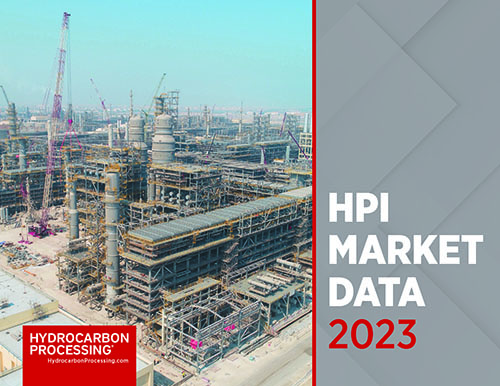
Discover how several global impacts—such as Russia’s war in Ukraine, supply chain crises and inflation—have and will impact spending and business activity in the global petrochemicals, refining and natural gas/LNG industries. HPI MARKET DATA 2023 is the processing industry’s most trusted forecast of capital, maintenance and operating expenditures.
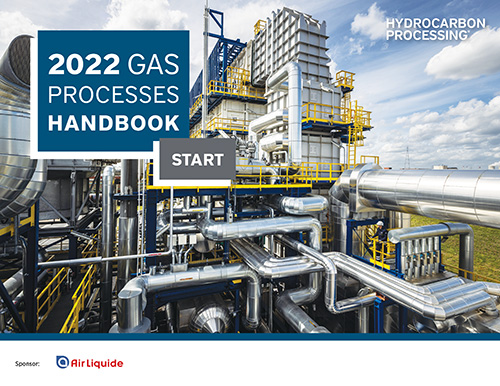
This handbook-type industry reference source is produced by the staff of Hydrocarbon Processing. It contains flow diagrams and descriptions of more than 170 commercially viable gas processing processes from 25 licensors. Included are drying, treating, dehydrogenation, effluent cleanup, hydrogen, liquefied natural gas, syngas, sulfur, liquid treating, etc. Each process description includes a flow diagram as well as application, economics and licensor information. The processes are indexed by process and contributing company.
- HxGN LIVE Global 2023: Optimization at scale 6/14
- IRPC 2022: Combining incremental crude processing and enhanced residue upgradation at low cost 9/26
- IRPC 2022: Tackling the dual challenge through AI enabled advanced control 9/26
- IRPC 2022: Solution for safe, reliable, process measurements 9/26
- U.S. Energy Secretary supports industry partnerships, energy transition 3/11
- CERAWeek: Digitalization is key in industry pursuit of net-zero 3/11