


May 2026
Special Focus—Biofuels, eFuels and Renewable Fuels
Benchmarking reverse water gas shift archetypes for eSAF production
As a drop-in solution that is deployable today, sustainable aviation fuel (SAF) is widely regarded as an important lever in decarbonizing aviation.
Current SAF demand is dominated by bio-SAF produced from biomass or waste-derived feedstocks, such as used cooking oil and animal fats; however, the availability of these feedstocks is limited. Consequently, advanced bio-SAF, made from a wider range of bio-residue feedstocks, including woody biomass and agricultural waste, is positioned to play a more prominent role in meeting long-term demand.
That said, neither type of bio-SAF will be sufficient to meet total long-term demand, particularly in geographies without abundant supplies of sustainable biomass. Consequently, eSAF (synthetic SAF)—produced using renewable (green) hydrogen (H2) combined with captured carbon dioxide (CO2) via power-to-liquids (PtL) technology—is set to play an increasingly important role in meeting future SAF demand.
eSAF production can follow several PtL pathways. The most established is via the commercially proven Fischer–Tropsch process (FIG. 1). The key to unlocking this pathway is reverse water gas shift (RWGS) technology for syngas production, a route that is currently being derisked and scaled up for deployment at commercial scale.

FIG. 1. RWGS is a key part of the Fischer-Tropsch-based PtL process for eSAF production.
In this article, the authors present the results of a benchmarking study that compares four competing RWGS technologies. Based on their findings, the authors suggest that low-temperature catalytic RWGS, which uses indirect electrical heating, may offer the most attractive route when assessed against key economic and operational criteria.
Benchmarking RWGS technologies. Benchmarking employed a model-based approach involving the development of process simulation models that compare four competing RWGS technology archetypes:
- Partial oxidation (POX)-based RWGS
- Autothermal reforming (ATR)-based RWGS
- Reforming-based RWGS (catalytic and direct electrical heating)
- Low-temperature selective RWGS (catalytic and indirect electrical heating).
The analysis integrated insights from the process modeling activity carried out, pilot-scale plant data (where available) and publicly available literature. For example, technology Archetypes 1–3 were evaluated primarily through modeling based on publicly available information, including patents, whereas the assessment of technology Archetype 4 also incorporated data from > 10,000 hrs of pilot plant operation by the authors’ company and its partnera.
For each archetype, the modeled system boundary included the RWGS reactor and a downstream CO2 removal unit used to recover and recycle unconverted CO2. However, it excluded integration with the downstream Fischer–Tropsch unit, meaning that efficiency and cost comparisons reflect only the RWGS, including the CO2 recovery system. Several relevant process model parameters obtained from literature are summarized in TABLE 1.
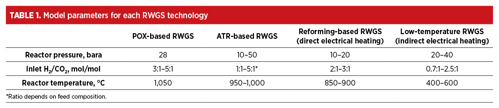
POX-based RWGS. The POX-based RWGS process requires substantial heat and high pressure to drive the reduction of CO2 to carbon monoxide (CO). Using a gasifier-based design, heat is provided by combusting feed H2 with oxygen (O2); however, the partial consumption of feed H2 results in lower overall process efficiency compared with catalytic RWGS technologies.
ATR-based RWGS. The ATR-based RWGS process involved tuning the H2/CO2 and O2/H2 (O2 being fed to combust some H2 for heat generation) ratios to optimize syngas composition and reactor outlet temperature, respectively. Reactor temperature and coking were further controlled by the addition of steam. Ideally, offgases from the downstream Fischer–Tropsch process can be recycled back through the ATR via a pre-reformer. The model was based on a nickel-based catalyst.
Reforming-based RWGS (catalytic and direct electrical heating). The reforming-based RWGS model employed direct resistive heating, with heat transferred to a thin layer of catalyst on the inside of a multi-tubular monolith system. The temperature distribution was controlled to promote exothermic methanation at the top of the reactor, which could partially drive the endothermic RWGS process towards the bottom. The process model catered to the recovery and recycling of unconverted CO2.
Low-temperature selective RWGS (catalytic and indirect electrical heating). The low-temperature selective RWGS uses indirect electrical heat transferred via a molten alkali salt mixture to drive the RWGS reaction. To prevent salt decomposition, the process operates below 600°C (1,112°F)—the lowest temperature of the four RWGS technologies modeled. The RWGS reaction occurs in a conventional shell-and-tube fixed-bed reactor. The reactor outlet temperature is controlled by a feed–effluent heat exchanger, and unconverted CO2 is recovered and recycled. A highly selective transition metal catalyst ensures high conversion despite low-temperature operation.
HOW THE RWGS ARCHETYPES COMPARE
Results from the benchmarking analysis have been used to assess each RWGS archetype against four key metrics that are central to operations and commercial viability:
- Capital expenditure (CAPEX)
- Operational expenditure (OPEX)
- Technology maturity
- Thermal efficiency (TABLE 2).
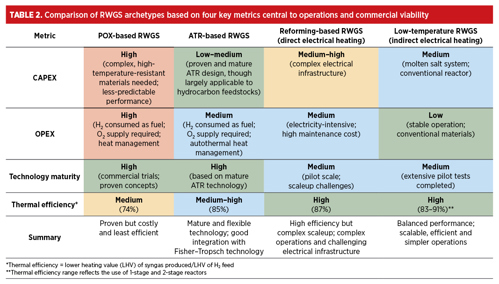
POX-based RWGS. POX-based RWGS is built on the well-established POX gasification technology, backed by extensive commercial trials and a proven reactor concept. That said, CAPEX is estimated to be the highest of the four archetypes, due to system complexity, less-predictable reactor performance (due to complex mixing patterns and temperature distributions) and the need for expensive, high-temperature-resistant materials that can withstand high reactor temperatures. In addition, ongoing heat management (including heat removal from the syngas produced) and modest thermal efficiency, the need for O2 (which may need to be produced onsite or transported in) and the consumption of expensive feed H2 as fuel results in high estimated OPEX.
ATR-based RWGS. ATR-based RWGS is built on mature, industry-proven ATR technology, which includes a relatively simple reactor design and a known catalyst. It has the lowest estimated CAPEX of the four archetypes and can be integrated for co-feeding hydrocarbon offgases and naphtha. However, similar to POX-based RWGS, ATR-based RWGS requires ongoing autothermal heat management and significant heat removal from the syngas produced, thus lowering overall process efficiency and increasing OPEX. Additionally, it needs a reliable O2 supply and consumes feed H2 as fuel.
Reforming-based RWGS (direct electrical heating). Demonstrated at pilot scale, reforming-based RWGS uses a compact reactor design and shows high single-pass CO2 conversion rates and thermal efficiency. Additionally, it can be co-fed hydrocarbon offgases or methane and enables faster shutdown and startup. These benefits, however, are offset by challenging channel fabrication and complex electrical infrastructure, which increase CAPEX. Moreover, heat degradation of iron–chromium–aluminum alloy and high electricity demand result in higher lifetime OPEX. The complex electrical system makes reforming-based RWGS challenging to scale.
Low-temperature RWGS (indirect electrical heating). Low-temperature RWGS has also been successfully demonstrated during extensive pilot testing. It uses a molten salt and a conventional reactor design in a system that has proven stable and efficient across a broad range of operating conditions. Moreover, it has high thermal efficiency—the highest of the four archetypes—driven by feed effluent heat integration. This results in the lowest potential OPEX of the technologies studied. Additionally, despite low-temperature RWGS being slower to start up and shut down, and showing lower single-stage CO2 conversion, it operates at lower temperatures than alternative catalytic RWGS solutions and therefore can be constructed from conventional and less expensive materials, reducing estimated CAPEX. The use of a conventional multi-tubular reactor design also means that low-temperature RWGS may be the easiest to scale of the four archetypes modeled.
Discussion. The benchmarking study of RWGS archetypes reveals a broad landscape of reactor concepts, each with distinct advantages and limitations.
High-temperature POX and ATR-based processes are commercially proven and mature technologies with good integration potential; however, they suffer from lower thermal efficiencies, consume expensive feed H2 for heat generation and require pure O2. Alternatively, the reforming-based, direct electrically heated reactor demonstrates high thermal efficiency but faces scaleup and electrical infrastructure challenges.
In contrast, the low-temperature catalytic RWGS, which uses indirect electrical heating technology, stands out for its balanced efficiency, scalability and operational simplicity, making it a compelling option for commercial deployment.
Takeaways. According to industry projections, stricter aviation fuel mandates, such as the European Union’s (EU’s) ReFuelEU, are set to drive long-term demand for SAF, in particular eSAF, which could account for a significant share of demand by 2050. Consequently, the development of commercial-scale RWGS technologies as a key part of the PtL process is becoming increasingly important.
With several RWGS pathways available for the PtL process, it is critical for decision-makers to know the advantages and limitations of each. The results of this study suggest that low-temperature RWGS, powered by indirect electrical heating, could offer a preferable pathway based on the economic and operational metrics evaluated.
NOTE
a The pilot project is a joint project between Shell Catalysts & Technologies and DWE GmbH (previously MAN Energy Solutions Deggendorf)



Comments