


Iran, Ukraine wars deliver worst hit in years to oil refining output
- Almost 9% of global refining capacity offline
- Damage and run cuts impacting output
- Diesel, jet fuel among biggest price rises
- IEA has cut Middle East, Russian refinery processing outlooks
Refinery attacks tied to the wars in Iran and Ukraine have knocked out nearly 9% of global oil refining capacity in recent months, deepening a fuel supply crunch and likely delaying recovery by months after fighting ends.
The Iran war has not only slashed energy supply by disrupting tanker traffic out of the Gulf, but marks the biggest hit to refining since the COVID-19 pandemic in 2020, with damage to facilities and crude shortages forcing cuts in processing.
"The current tightness will continue to underpin the refined product market," Saxo Bank analyst Ole Hansen told media. "Not least considering the damage done to refineries."
Crude prices have surged, with benchmark Brent hitting $126 a barrel in April, a four-year high. Some prices have risen even faster, including jet fuel, which hit a record high in March.
Tightened supply has forced refiners, traders and retailers to tap crude and fuel inventories to meet demand.
About 500 MMbbl of oil have been drawn from stocks, TotalEnergies CEO Patrick Pouyanne said on April 29, adding the figure could rise to 1 Bbbl given the time needed to restart facilities and deliver to Asia.
"Even if the war was to end quickly, prices are expected to remain at high levels," he said.
WAR DAMAGE ADDS TO CAPACITY CRUNCH. Daily demand for liquid fuels including gasoline, diesel, jet fuel and fuel oil derived from crude is about 104 MMbbl.
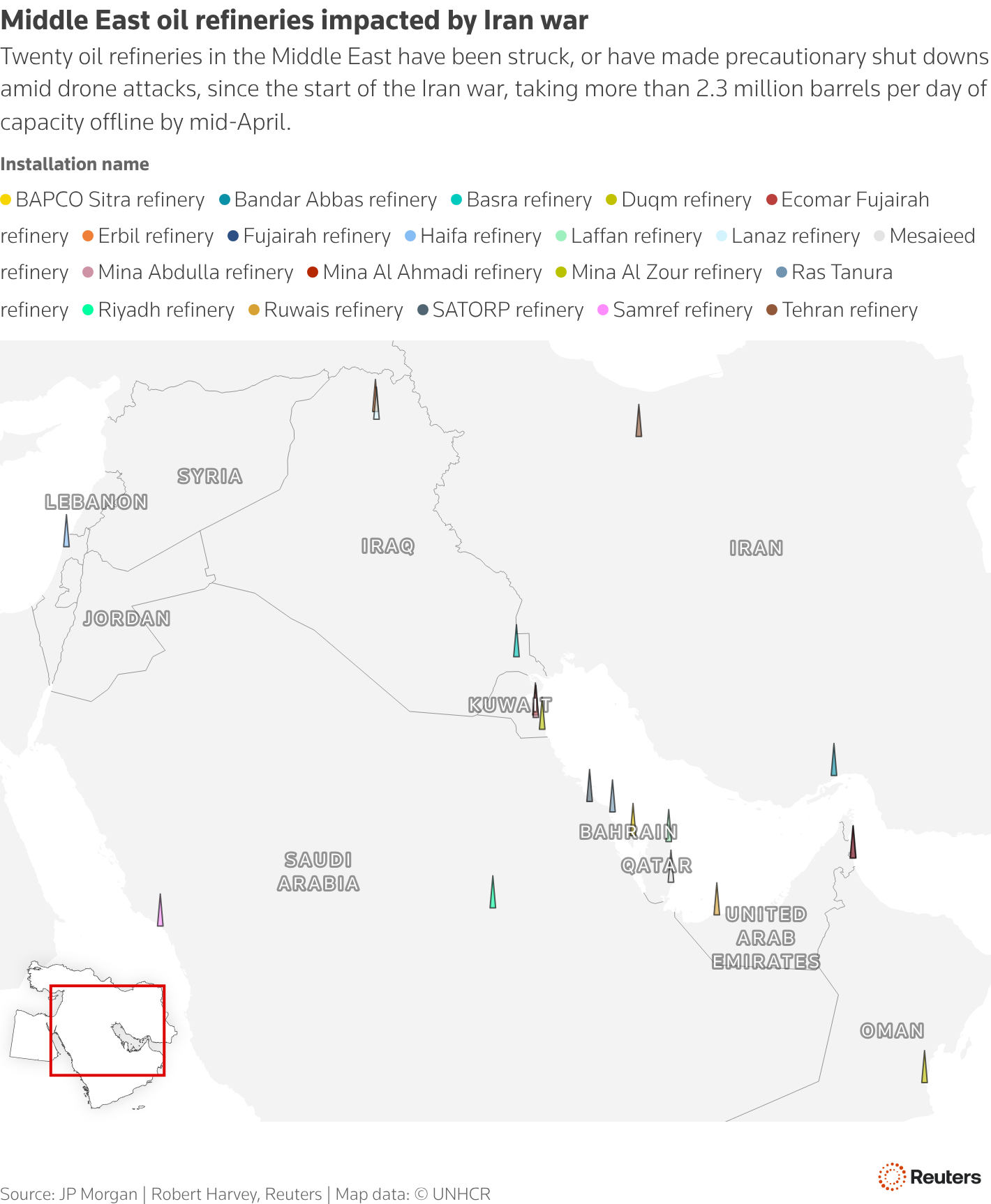
The Iran war had shut as much as 3.52 MMbpd of refining capacity as of May 7, according to industry monitor IIR.
(click image to enlarge)
Refineries impacted include the 550,000-bpd Ras Tanura plant, Saudi Arabia's largest. It has restarted, though some units are undergoing turnaround, Saudi Aramco CEO Amin Nasser said on Monday.
Two of Kuwait's three refineries - Mina Al-Ahmadi and Mina Abdullah - were hit by drones. Both, as well as the 615,000-bpd Al-Zour refinery, Kuwait's largest, have lowered processing rates.
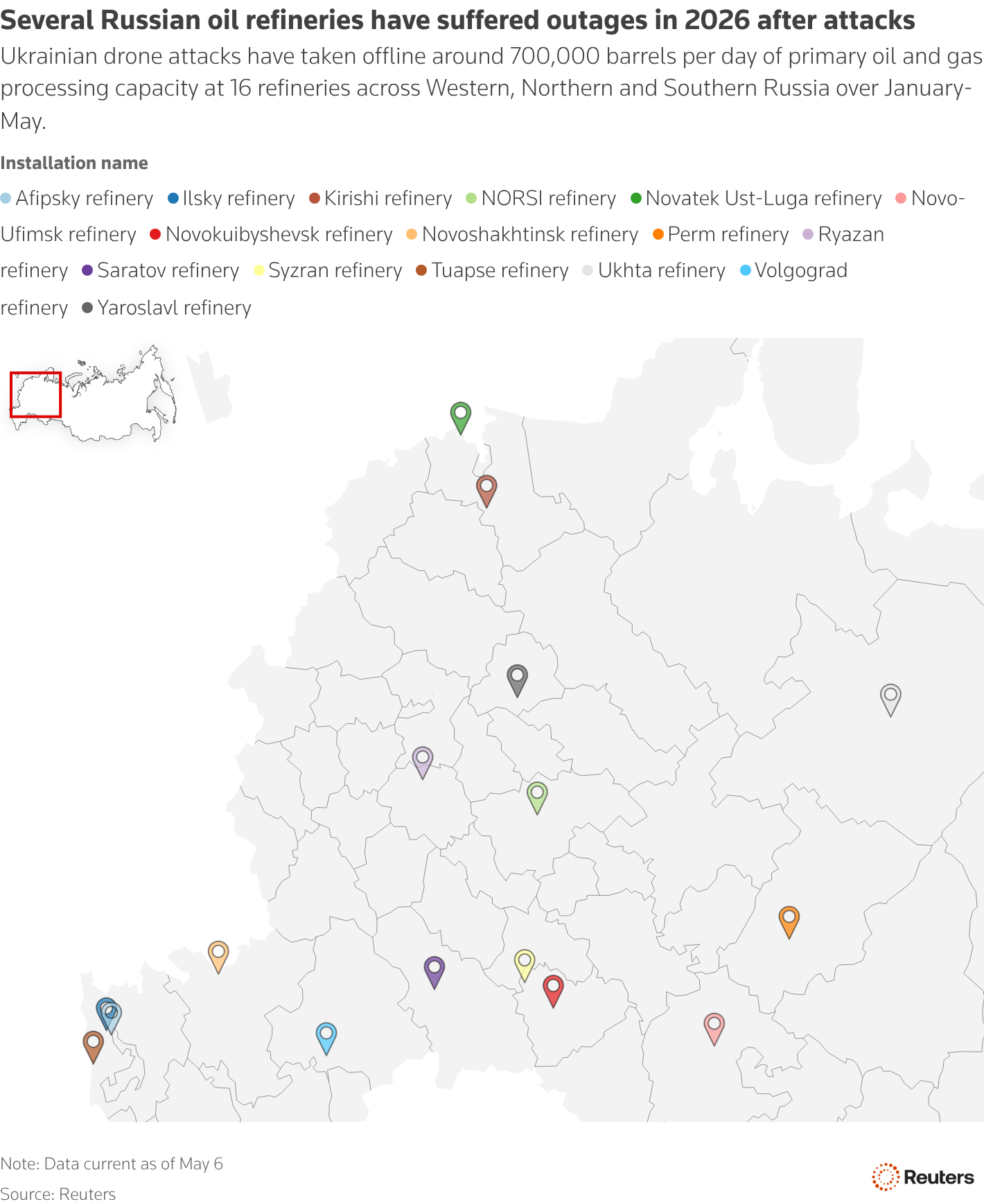
War between Russia and Ukraine has also removed an additional 1.42 MMbpd, IIR said.
Reuters calculations show Ukrainian drone attacks aimed at disrupting Moscow's war machine have forced about 700,000 bpd in Russian crude processing capacity offline between January and May at 16 sites.
(click image to enlarge)
Across Asia and Europe, a shortage of crude has reduced refinery processing volumes by about 3.8 MMbpd, according to JPMorgan analysts.
The outages linked to the two wars equal almost 9% of the 100.5 MMbpd of global refining capacity, according to IIR.
JET FUEL, DIESEL MOST IMPACTED. "Lower refinery runs in Asia and Russia have had a disproportionately large impact on gasoil and diesel," FGE analyst Qilin Tam said. "We see the balance in Asia flipping from a solid regional surplus to a glaring regional deficit."
Oil product stocks on May 7 in oil hub Singapore hit their lowest in more than nine months, official data showed.
Europe could face jet fuel shortages as early as June if Gulf supplies are not fully replaced, the International Energy Agency has said.
Reflecting that shortfall, Nigeria's giant 650,000-bpd Dangote refinery almost doubled its exports of jet fuel to Europe in April, Kpler data showed.
EU diesel prices at the pump hit a record €2.11 per liter in April, according to European Commission data, reflecting lost Gulf supply and halted intake from Russia, once Europe's top supplier, over the Ukraine war.
COULD TAKE MONTHS. The refining industry entered the year with limited spare capacity after closures during and since the pandemic, Energy Aspects analyst George Dix said.
About 9.69 MMbpd of capacity closed between 2019 and 2026 because of the pandemic, operational issues, poor economics and the gradual rise of electric vehicles, IIR data showed, or about 10% of current working capacity.
A return to normal is likely to take months.
The IEA expects processing at Gulf refineries to fall to 8.7 MMbpd this year, down 900,000 bpd from 2025.
It has also lowered its forecast for Russian crude runs in 2026, pegging them as low as 4.8 MMbpd in the second quarter versus around 5.2 MMbpd earlier this year, citing Ukrainian attacks.



Comments