


nova-Institute provides scientific basis for EU policy on bio-based plastic packaging under PPWR
- New analysis for the European Commission confirms no technical barriers to bio-based packaging, highlights average GHG emission savings, and recommends binding targets to drive defossilization
The nova-Institute, a leading research and consultancy organization in the field of renewable carbon, has been commissioned by the European Commission to provide a comprehensive analysis on the role of bio-based feedstocks in plastic packaging under the Packaging and Packaging Waste Regulation (PPWR). The study delivers robust, science-based insights into technological development, environmental performance and policy options, supporting the European Commission in shaping future sustainability criteria and targets for bio-based plastics.
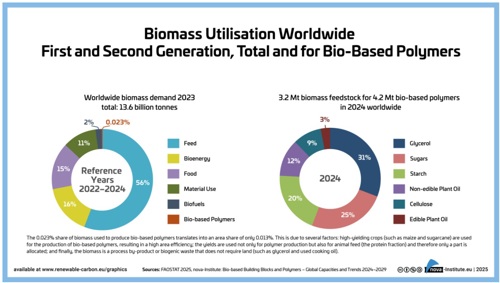
The report fills a critical gap: although plastics remain over 99% fossil-based and bio-based polymers account for only ~1% of the global market, they are technologically mature. Seventeen bio-based polymers are commercially available today, and the study finds no fundamental technical barriers to their use in packaging. At the same time, the PPWR introduces binding recycled content targets but leaves open how bio-based carbon can contribute to defossilization. The study addresses this gap by providing evidence on significant greenhouse gas reduction potentials, the availability and scalability of bio-based polymers, and the need for harmonized sustainability criteria aligned with the Renewable Energy Directive. It also highlights the importance of recognizing the complementarity between bio-based and recycled carbon, rather than treating them as competing solutions. Advancing these approaches is essential to ensure sufficient non-fossil carbon supply for the plastics sector and to enable a climate-neutral, circular carbon economy – a transition that nova-Institute has been actively shaping for decades.
“For more than 30 years, we have been working on defossilizing the chemicals and materials sector,” says Michael Carus, founder and senior advisor of the nova-Institute. “Our analysis shows that a climate-neutral packaging sector will require a balanced mix of bio-based carbon, CO₂ utilization and recycling. When it comes to packaging, this means increasing both the share of bio-based content and the use of recycled materials. Only by combining these approaches can we fully keep carbon in the loop and successfully transition from fossil to renewable carbon.”
Bridging the Gap: Bio-based Content in EU Packaging Policy. The PPWR sets ambitious targets for recycled content in plastic packaging, but the role of bio-based feedstocks is not yet fully defined. This creates a critical gap in the policy framework: while recycling is essential, it alone cannot provide sufficient non-fossil carbon as a feedstock to meet demand and long-term climate targets. The study highlights that bio-based feedstocks can play a complementary role by introducing new renewable carbon into the system, reducing dependence on fossil resources.
In this context, the report emphasizes the importance of recognizing the equivalence and complementarity of bio-based and recycled content. Both approaches contribute to defossilization, but in different ways: recycling keeps existing carbon in use, while bio-based feedstocks bring in additional renewable carbon. A balanced policy framework that supports both is therefore key to ensuring a resilient and circular carbon system in the European packaging sector.
Unlocking Climate Benefits: Performance and Scalability of Bio-based Plastics. Despite their currently small market share, bio-based plastics are technologically mature and already available for a wide range of applications. The study shows that there are no fundamental technical barriers to their use in packaging, with 17 bio-based polymers commercially available today. In addition, many of these materials offer significant greenhouse gas emission reductions compared to fossil-based alternatives, making them a valuable tool for achieving the EU’s climate targets.
However, scaling up production remains a key challenge. Higher production costs, limited infrastructure and uneven policy support compared to biofuels slow down market uptake. The report therefore calls for targeted measures such as binding bio-based content targets, harmonized sustainability criteria and investments in recycling and processing infrastructure. Addressing these barriers will be essential to unlock the full potential of bio-based plastics and accelerate their role in a climate-neutral packaging system.
From Insight to Implementation: Supporting the Renewable Carbon Transition. “We welcome that the European Commission has chosen to draw on independent scientific advice from nova-institute,” says Dr. Lars Börger (CEO of nova-institute). “In complex transformation processes, policy needs an unbiased view of the best available scientific evidence. This is what makes Europe strong and it is also what nova stands for”.
With its long-standing expertise in renewable carbon, nova-Institute supports companies, policymakers and investors in navigating the transition from fossil to sustainable carbon sources. Through in-depth studies, market data, strategic consulting and widely accessible resources such as free reports and the Renewable Carbon Initiative, nova provides guidance on technologies, markets, sustainability and regulatory developments. By combining scientific analysis with practical implementation support, nova-Institute actively contributes to advancing the renewable carbon economy and enabling stakeholders to turn ambitious climate targets into actionable strategies.



Comments