


Oil market clock is ticking as supply crunch looms
The oil industry has shown remarkable resilience in the face of the largest energy supply shock in modern history, pulling multiple levers to cushion the blow of the Iran war. But barring a breakthrough in peace talks, the global market may be only months away from a breaking point.
The world’s biggest and most liquid commodity market has entered a phase of unprecedented uncertainty since the outbreak of the Iran war and the near-hermetic closure of the Strait of Hormuz – previously the conduit for a fifth of global oil and gas supplies.
Before the conflict began on February 28, few experts anticipated that Iran would actually shut down the Strait. Almost no one thought the obstruction would stretch into months.
Now, with peace efforts faltering and the risk of renewed military escalation still high, markets can no longer dismiss the possibility that transit through Hormuz will remain constrained for many more weeks.
But the clock is ticking. The oil market likely has about three months before tightening supplies begin to bite in earnest, pushing inventories to critical lows, triggering sharper price gains and ultimately forcing demand destruction and broader economic pain.
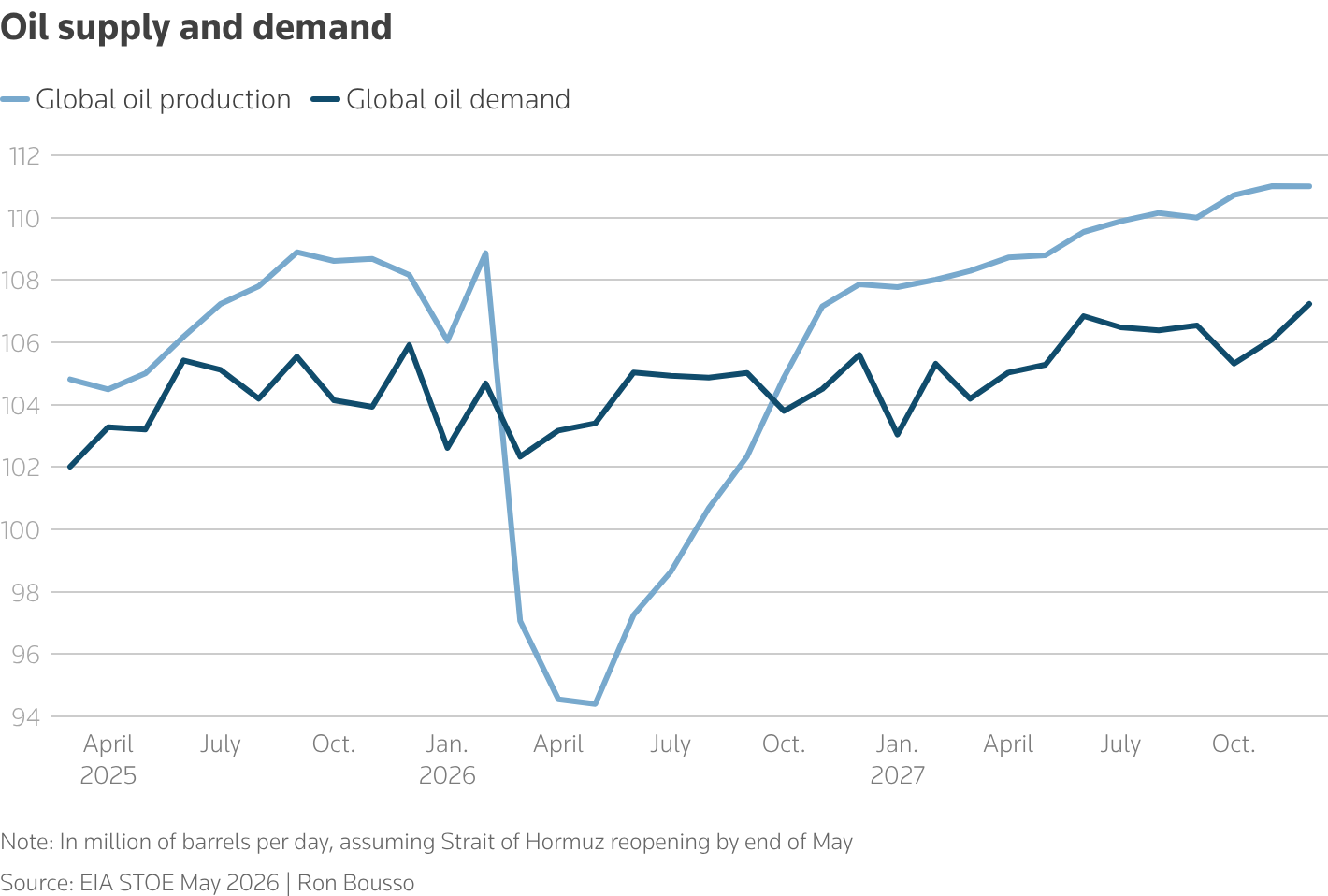
MUDDLING THROUGH. The industry’s response to this historic crisis, involving the loss of roughly 13 MMbpd of supply, has been strikingly effective so far.
Import-dependent economies, particularly in Asia, moved quickly to secure alternative sources of supply, mostly in the U.S. and Latin America. Traders and refiners tapped into inventories, while the International Energy Agency coordinated a record 400-MMbbl release from member states’ strategic reserves.
(click image to enlarge)
Even so, absorbing the shock has come at a cost. Demand is already contracting as refiners cut production runs, airlines trim schedules and governments implement fuel-saving measures. The IEA estimates global oil demand will fall by 2.4 MMbpd in the second quarter from a year earlier, representing about 2.3% of pre-war consumption.
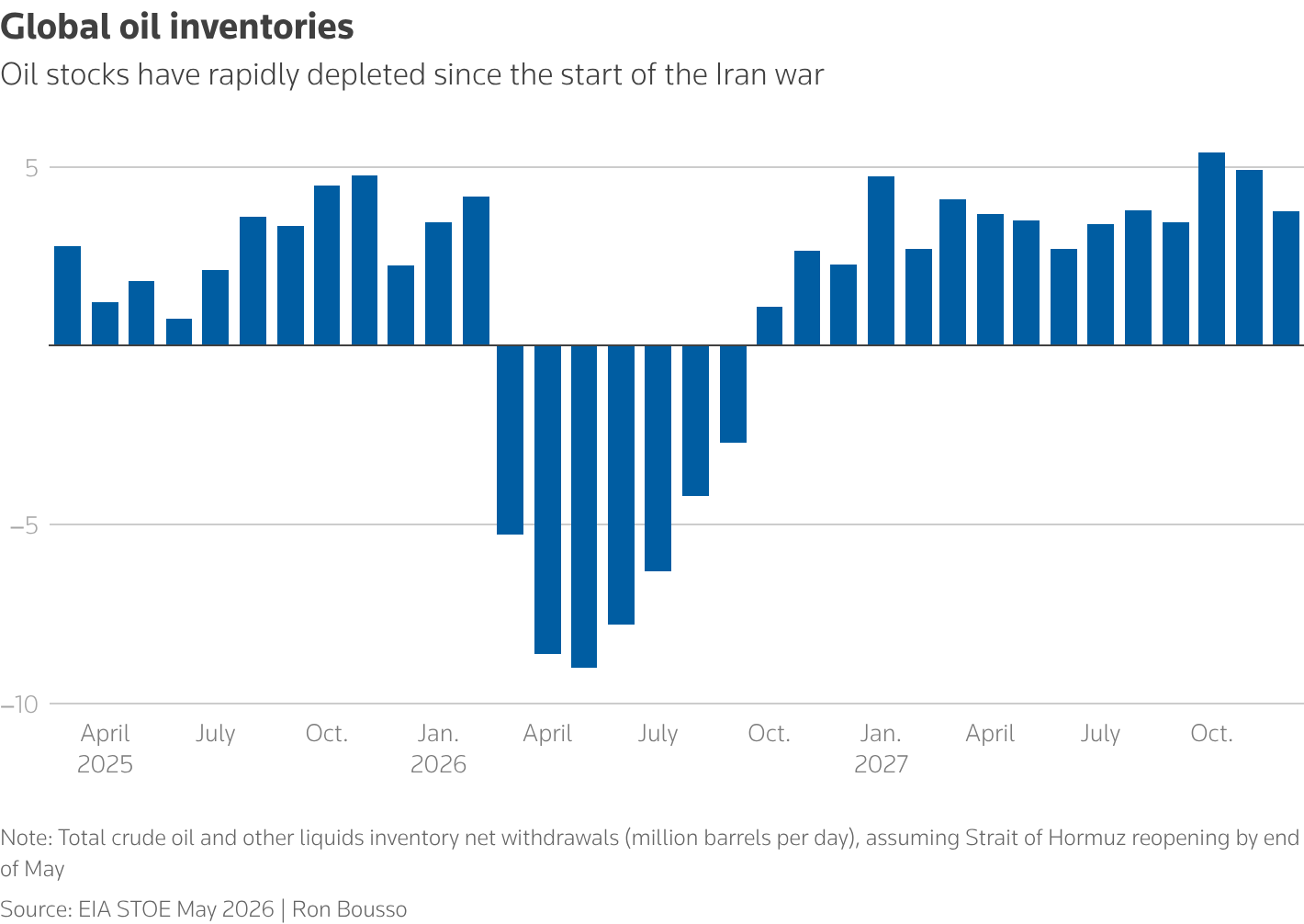
Crucially, those adjustments have been accompanied by a rapid drawdown in inventories - the system’s primary shock absorber.
(click image to enlarge)
U.S. Energy Information Administration (EIA) data showed global crude and fuel stocks fell at a pace of 5.27 MMbpd in March, accelerating to 8.62 MMbpd in April.
Draws are expected to peak at around 9 MMbpd in May before slowing to 2.7 MMbpd by September, according to the IEA. At that point, inventories are projected to begin rebuilding.
But those projections rest on a critical assumption: that the Strait of Hormuz reopens by late May and traffic resumes in June. That timetable now looks highly optimistic to say the least, suggesting stock draws may prove both deeper and longer-lasting than official forecasts imply.
Indeed, veteran independent analyst Paul Horsnell estimates a much steeper rate of depletion: 7.4 MMbpd in March, 10.8 MMbpd in April, 10.2 MMbpd in May and 11.2 MMbpd in June. That would amount to a cumulative loss of around 1.2 Bbbl of global inventories.
At this pace, some commercial inventories could fall to minimum operating levels – thresholds below which storage systems can no longer function efficiently – as early as August, according to Horsnell.
SYSTEMIC BREAKDOWN. Yet history suggests markets rarely reach such hard limits. As the past few months have shown, participants tend to act early, adjusting quickly and efficiently to avoid systemic breakdown.
There are several important caveats.
For one, the timeline for the reopening of the Strait of Hormuz remains highly uncertain, and any partial resumption of flows could materially ease pressure on global supply.
Moreover, technical constraints in storage systems are unlikely to be reached everywhere at once. Shortages would probably emerge unevenly and sporadically rather than in a synchronized global crunch.
Prices themselves also serve as a powerful counterbalancing mechanism. Oil prices have historically been negatively correlated with observable inventory levels, rising as inventories fall.
A continued sharp depletion would therefore likely drive prices higher, ultimately curbing consumption and alleviating some of the strain. Global benchmark Brent crude futures LCOc1have climbed about 50% since the start of the war to around $110 a barrel, but based on the scale of the crisis, they still have far more room to run.
China represents another key variable. Beijing holds the world’s largest oil stockpiles - estimated at around 1.2 Bbbl at least - and could provide additional relief if it opts to draw down inventories and further scale back imports.
In other words, the market still has buffers. But they are finite and being consumed rapidly.
With each passing day of constrained flows through Hormuz, the strain on the global energy system intensifies. The breaking point may yet remain elusive — thanks to a combination of policy choices, price responses and geopolitical developments — but it is steadily drawing closer. And if it ever does arrive, it will pack a punch.
The opinions expressed here are those of Ron Bousso, a columnist for Reuters.



Comments