

ChemE panel: Scaling circularity and pathways to a sustainable future
Following Wednesday morning’s keynote address on Day 2 of ChemE Show powered by ACHEMA, an engaging panel discussion, “Strong sustainability demand,” was moderated by Mitchell Toomey, VP – Sustainability & Responsible Care®, American Chemistry Council; and featured Séval Schichtel, Global Business Development Manager, Clariant Catalysts, and Kyle Findley, Director – Business Strategy for Green Circle, Lummus Technology.
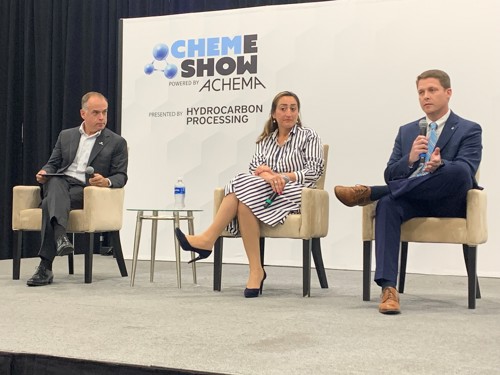
“From rethinking feedstocks and designing for circularity to scaling technologies that reduce waste and emissions, this topic sits right at the center of how we build a more sustainable and competitive future for the chemical industry of manufacturing,” said Toomey.
Findley spoke briefly about Green Circle, a business unit within wellness technology at Lummus Technology. “The purpose of Green Circle is to develop and commercialize new technologies, particularly in the spaces of circularity and sustainability…typically up to the demonstration level. We view circularity as an industrial systems challenge, not just a single technology challenge, and our technologies are designed to work in existing assets.”
“Globally, we produce some 400 MM tons of plastic each year,” Schichtel said. “I was shocked to discover how much of this was going to single-use plastics. We have a responsibility to change this. Clariant feels that we need fully integrated solutions. We need to be adaptable to the needs of customers, so we have what we call a multi-stage product portfolio.
The panel agreed that from an engineering perspective, a truly circular plastics recycling/reuse system is not just one technology, but rather coordinated change. This includes collection, pre-processing, conversion, upgrading, product certification and market acceptance.
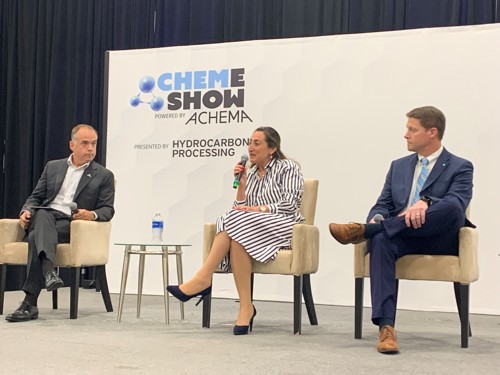
“I think the technologies that scale are the ones that solve more than just the chemistry,” Findley said. “A pilot can prove technical feasibility, but commercial deployment requires reliable feedstock, operational robustness under real-world operating conditions, product quality that can meet downstream requirements and a business case that can adapt with ever-evolving market conditions. Pilots units are never intended to be profitable, so it’s critical to evaluate how CAPEX and OPEX are going to scale.”
“That’s a challenge in jumping into an industry and adding a disruptive change like this, you have to accommodate the legacy designs and try to work around some of the limitations presented by how we used to do things,” Toomey said. “We’re going to see more designing for circularity up front.”
Schitchtel echoed that sentiment. “Even in R&D, it is a must to ask ‘do we have a better alternative?’ The customer has an important role to play. We see the change in consumption behavior…they are asking where did the product come from, and what is the environmental impact. On a higher and more systemic level, we absolutely advocate for policy frameworks and regulations to support this transition. We have the tools to make changes, but we also need the technology to be economically viable and competitive, and for the risk to be reduced.”


Comments