

ChemE panel: The pathway to optimizing mega-project construction
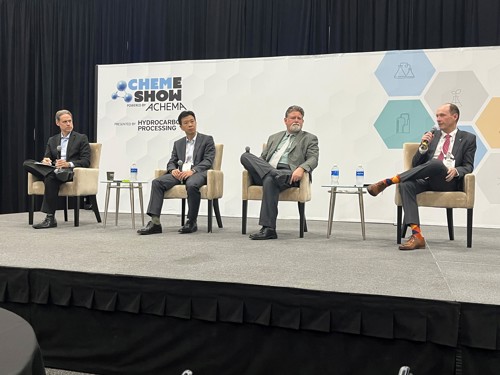
The final panel discussion of the ChemE Show powered by ACHEMA on Wednesday morning featured a discussion, “Designing and delivering the next generation of chemical assets,” with a particular focus on mega projects. The panel was moderated by Lee Nichols, SVP of Content for Gulf Energy Information and Editor in Chief for Hydrocarbon Processing, and featured (second from left to right in the image below) Jiang Rui, Expert, Sinopec; Russel Schultz, VP – Project Management, Fluor; and Alejandro S. Carrillo, VP and Managing Director – Ethylene, for Lummus Technology.
“As projects get bigger and bigger, it really puts stress on engineering and resources,” said Schultz. “Where are you going to get the materials and how are you going to get them to the job site in time to support the mechanical completion so it’s ready for startup dates? One of the first projects I worked on had four EPCs (engineering, procurement and construction companies), and now it’s not uncommon to have 20 or more on a major petrochemical complex. It’s a huge logistics endeavor, and if you don’t put the time in up front to plan that, it can add significant costs to your project.”
“Any project in the billion-dollar scale is more vulnerable to the uncertainties that can happen everywhere around the world,” Rui agreed. “For example, in one project we executed years ago, there was a strike in South Korea. It had a ripple effect, stopping the ship line, the logistics were interrupted and the price tripled for the shipment.”
For mega projects, Carrillo stressed that there can be multiple license packages, which is very challenging from a construction perspective. “Someone has to manage these interfaces and ensure they are all well-aligned,” he said. “Any misalignment is going to cascade down.”
Nichols asked how those challenges are addressed in the early stages of a project. “It’s very important in these large multi-billion dollar projects to take the time in the feasibility and front-end engineering design (FEED) stage to define the project, develop your execution strategies and not rush through those early planning phases that are so key to project success. I like to tell clients their best ROI is the money they spend on feasibility and FEED,” Schultz said.
Rui spoke about Sinopec Engineering and its EPC projects. “In the past three decades in China, we acted as the major EPC undertaker in approximately 90% of refinery facilities and 60% of ethylene capacities. In the past 10 years, we have expanded overseas to refinery projects in the Middle East, LNG purification projects with our partners, refinery projects in Malaysia, and some LNG projects in Algeria.”
The discussion moved to how some of these mega projects are so big that they can impact global pricing. “How can owners protect themselves from this challenge?” Nichols asked the panel. One answer was that market intelligence was an important factor, and working closely and communicating with partners, suppliers and licensors was a key aspect of the solution. Another was the careful selection of qualified contractors.
The group agreed that the number of such contractors was small with such mega projects.
The panel also addressed modularization, agreeing that one size could not possibly fit all, but that it had its advantages, including safety by removing work from the facility site. They also discussed their predictions looking ahead 10 to 15 years. The panel agreed that they envisioned artificial intelligence (AI) having a positive effect and a big impact on EPC and scheduling.

Comments