


From corn fields to cargo ships, ethanol gains early traction as marine fuel
Shippers including Maersk and mining giant Vale are turning to ethanol as a marine fuel to cut emissions as abundant supply and lower cost make it more attractive than other low-carbon fuels, with further commercial usage expected as early as next year.
The use of ethanol in shipping could open a new demand channel for the fuel, which in some countries is blended into gasoline, while offering shipowners another pathway to cut conventional fuel use to meet emission reduction targets.
Renewed interest follows mounting pressure on the global shipping industry to manage oil price uncertainty as hostilities in the Middle East and closure of the Strait of Hormuz, a vital waterway, highlight the risks of conventional fuel supplies.
"Volatile fossil fuel prices strengthen the long-term case for fuel diversification," said Chris Chatterton, maritime adviser at the Global Centre for Green Fuels (GCGF).
"What is distinctive about ethanol in this environment is that it can be deployed incrementally - as a blend into methanol on existing methanol-ready vessels, with no major retrofit and no capital commitment to a single-fuel strategy."
The shipping industry has been testing alternatives to fuel oil including liquefied natural gas, ammonia, biodiesel and methanol.
Ethanol trials on ships equipped with methanol engines. Shipping group Maersk MAERSKb.CO completed its first two sailings on 100% ethanol in the first quarter and last week, following earlier tests of 10% and 50% ethanol blends on a vessel designed to run on either methanol or fuel oil.
Maersk views ethanol as a complement to methanol, which has emerged in recent years as an alternative shipping fuel, although green methanol remains limited in supply.
"Ethanol is relevant to explore because it has an established global market and existing infrastructure, and it shares properties similar to methanol," a Maersk spokesperson told Reuters.
Singapore-based shipping group X-Press Feeders said it also trialed a marine fuel blend consisting of 10% ethanol and 90% methanol on a container vessel in Rotterdam.
Brazil-based Vale, which uses ships to transport iron ore, said it has contracted with China's Shandong Shipping Corp to build two vessels that can operate on ethanol, methanol or heavy fuel oil.
Ethanol can run on an existing methanol-compatible engine without major retrofits, according to engine-makers including Switzerland's Everllence.
The number of methanol-capable vessels is expected to reach 450 by 2030, up from 107 in 2025, DNV data showed. About 313 of those 450 vessels are newbuilds on order.
GCGF's Chatterton said green methanol, derived from renewable resources, faces near-term supply constraints.
"Maersk has been explicit that methanol availability is one of the principal challenges in scaling alternative fuels, and that is precisely why ethanol is being introduced into the mix," Chatterton said.
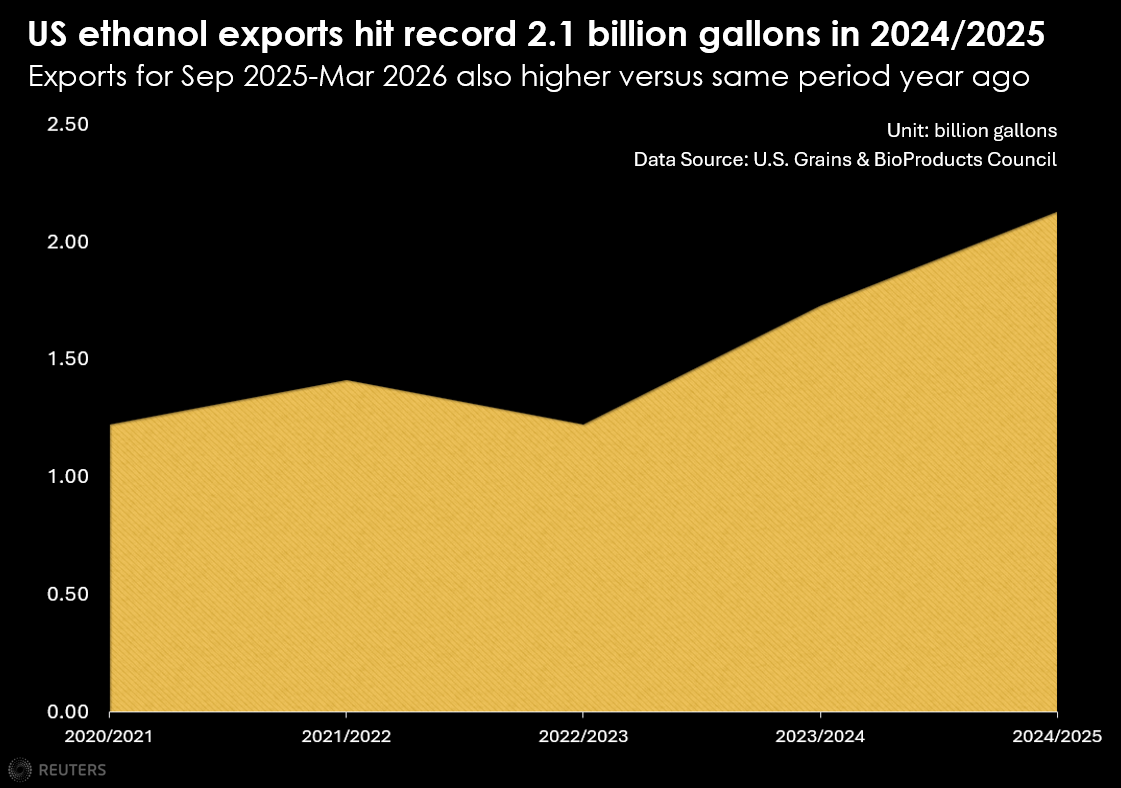
Abundant U.S., Brazilian corn. Ethanol's main feedstock is corn, which top producers, the U.S. and Brazil, have in abundance. Conventional methanol is derived from fossil fuels.
(click image to enlarge)
The U.S. Department of Agriculture has projected a 17-billion-bushel domestic corn supply for 2025-2026, the largest on record, as yield per acre improves.
The Renewable Fuels Association, a U.S. ethanol producers group, said if ethanol captures 5% of the global marine fuels market it would increase demand by 4 billion to 5 billion gallons and corn demand by 1.5 billion bushels.
U.S. biofuels trade group Growth Energy has lobbied for tax rules that would encourage the use of more ethanol.
Efficiency of ethanol. Ethanol contains around 35% more energy per kilogram than methanol, meaning ships require less fuel to travel the same distance. However, ethanol still lags conventional fuel oil in energy content, requiring about 50% more fuel by weight to achieve the same energy output.
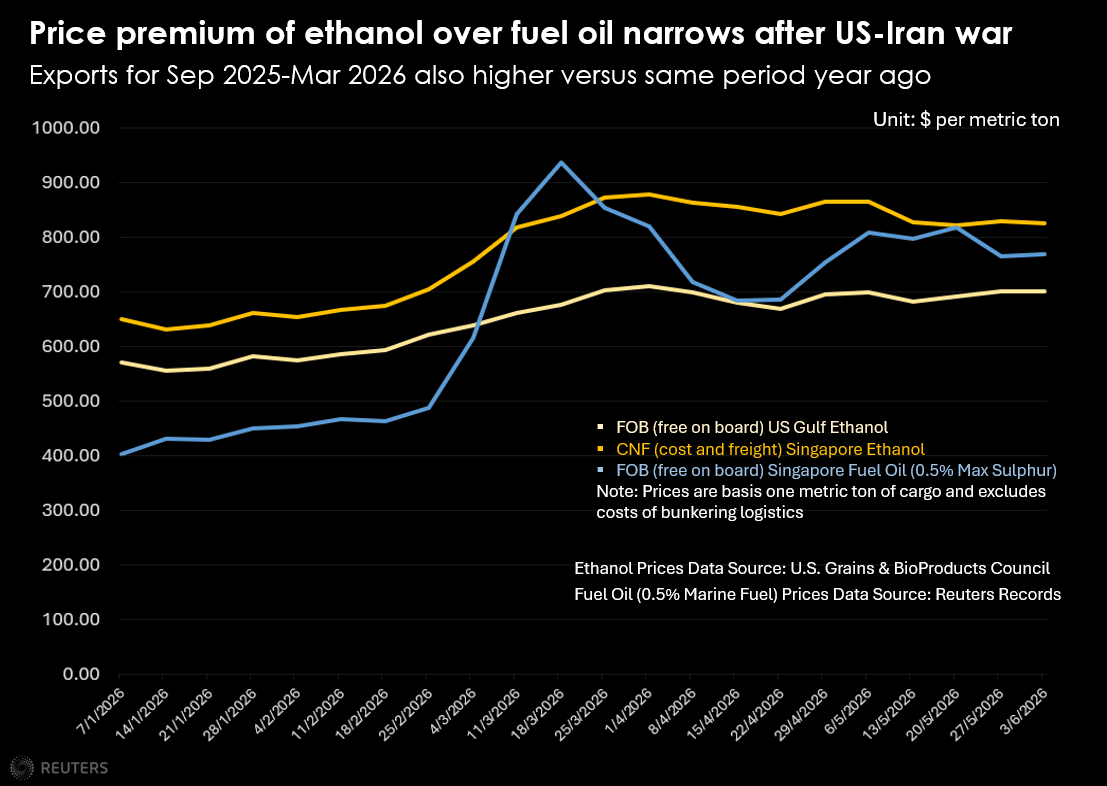
Depending on location and volume, the cost of ethanol is broadly comparable to conventional low-sulphur fuel oil (LSFO) but is cheaper than green methanol.
(click image to enlarge)
Ethanol cost about $700 per metric ton on a U.S. loading basis and over $800 on an Asia import basis as of early June, data from the U.S. Grains and Bioproducts Council showed.
By comparison, LSFO costs above $750 per ton in Asia, while green methanol can easily cost above $1,000 per ton, industry sources said.
Chatterton expects more commercial ethanol bunkering operations to emerge over the next 12 to 24 months, with Brazil's Santos and top bunker hub Singapore as likely first movers. Singapore has been developing infrastructure and standards aimed at scaling various alternative marine fuels.
"Additional early activity is expected in the U.S. Gulf, linked to export-driven ethanol supply chains," said Rostom Merzouki, global sustainability vice president at ship classification society ABS.
Merzouki expects first-pilot operations in Northwest Europe to expand to other key bunker hubs into the late 2020s.



Comments