


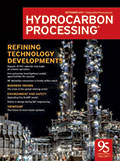
September 2017
Special Focus: Refining Technology Developments
In the collective experience of the authors, one of the most troublesome pieces of refinery fractionation equipment is the collector tray.
The function of fluid catalytic cracking units (FCCUs) is to maximize profits from a given barrel of oil.
Because of its clean-fuel properties (paraffinic, high octane, low vapor pressure and very low sulfur), alkylate is considered one of the most desired components in the gasoline pool.
Dividing wall column (DWC) technology is becoming more widely accepted throughout the process industries as a means to increase efficiency and reduce capital and energy costs.
Process Optimization
Dividing wall column (DWC) technology is becoming more widely accepted throughout the process industries as a means to increase efficiency and reduce capital and energy costs.
Environment and Safety
The ALARP (as low as reasonably practicable) model was developed by the UK Health and Safety Executive to establish and justify risk acceptability limits.
After process engineers complete their preliminary documents—process flow diagrams; material and energy balances; piping and instrumentation diagrams (P&IDs); process control philosophy; identification of the hazardous nature of raw materials, chemicals, byproducts and final products; process equipment layout drawings (plan and elevation); and unit plot plans—those documents are issued to engineers of other disciplines.
Columns
Over the past two years, the editorial comment in our September issue has focused on the topic of overcapacity in the global refining sector.
In an urgent communication, a paper plant customer reported that the mechanical seals in one of its ANSI pumps were moving axially whenever an unexpected process problem caused the normally liquid pumpage to turn into a thick, odorous gel.
Revamp projects are notorious for scope creep, cost and schedule overruns.
Alkylation units can be based on sulfuric acid or hydrochloric acid as a catalyst.
Technology gaps in the crude oil refining sector of sub-Saharan Africa (SSA) are making it difficult for crude oil processing plants to achieve energy efficiency, produce high-quality products or adhere to international carbon emissions requirements.
Engineering in the Cloud, standardized processes, automated data management, smart input/output (I/O) systems and soft marshalling are helping decouple hardware and software engineering activities.
When I ask people that work around machinery, “How do you improve reliability?” they often tell me to buy better bearings, seals, monitors or some other hardware-based improvement.
For both upstream and downstream operations, H2O is a critical resource in the oil and gas industry.
Between 2013 and 2015, numerous GTL facility projects were announced, primarily in the US. GTL technology was made attractive to investors by the onset of cheap natural gas prices (spurred by US shale gas exploration) vs. a spike in crude oil prices.
Trends and Resources
<i>Hydrocarbon Processing</i>’s Construction Boxscore Database is tracking nearly 700 refining projects around the world.
Over the past few years, the world has witnessed significant downstream capacity growth in all sectors of the hydrocarbon processing industry (HPI).
US margins recorded solid gains as crack spreads for all products increased due to healthy domestic demand.

- Evonik expands distribution partnership with IMCD for VISIOMER® Specialty Methacrylates in the U.S. 3/13
- RWE to invest €17 B in the U.S. to power data centers 3/13
- Petrobras' refineries operating at 97% of capacity 3/13
- ABB open to pursuing more than one multi-billion-dollar acquisition this year 3/13
- USW rejects bp's final offer to Whiting refinery (U.S.) workers 3/13
- Equinor has no spare oil and gas capacity, CEO says 3/13