

May 2026
Special Focus—Biofuels, eFuels and Renewable Fuels
FCC coprocessing of advanced biocrudes: Insights from continuous pilot testing
The fluid catalytic cracking unit (FCCU) remains one of the most flexible and economically important assets in a refinery, making it a leading platform for low-capital expenditure introduction of renewable carbon through co-processing.¹ While FCCUs can tolerate a wide range of feedstocks, tolerance alone does not define success. Renewable value is created only when biogenic carbon is efficiently converted into saleable hydrocarbon products without imposing operational or product quality penalties.
Not all biomass-derived liquids are equally suitable for FCC co-processing from a refinery value perspective. Advanced biocrudes are being developed to enable higher retention of biogenic carbon in liquid and gas hydrocarbons while preserving unit operability. This article presents continuous pilot FCC test results that compare fast pyrolysis bio-oil with an upgraded lignocellulosic biocrude, hereafter referred to as Alder Renewable Crude (ARC). The tests focused on three refinery-relevant outcomes:
- Feed storage stability
- Overall product yield and selectivity relative to conventional operation
- Efficiency of biogenic hydrocarbon production and oxygenate carryover.
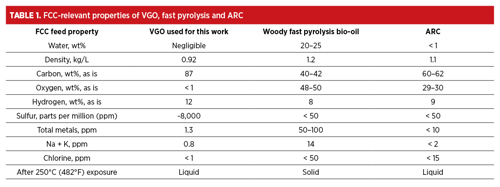
Refinery challenges with conventional biocrudes. Fast pyrolysis oils derived from woody biomass commonly contain 20 wt%–30 wt% water and elevated levels of alkali and alkaline earth metals, including sodium (Na), potassium (K), calcium and magnesium, often exceeding limits tolerated by FCC catalysts (TABLE 1). In FCC operation, these properties introduce several well-known risks. High water content disrupts heat balance and increases vapor loading at the FCC feed injection point. Alkali metals permanently deactivate catalyst acid sites, while calcium, iron and magnesium promote pore plugging and reduce catalyst accessibility. High oxygen content increases carbon monoxide, carbon dioxide and aqueous product formation, lowering hydrocarbon yields. Reactive oxygenated intermediates may also persist through cracking reactions and break through to the gas plant and fractionation systems, increasing downstream fouling and oxygenate corrosion risk.
Thermal instability and immiscibility with petroleum feeds further complicate storage, handling and feed system design. Phase separation and viscosity stratification introduce blending uncertainty and increase the risk of feed system upsets. While these issues are broadly recognized, their combined impact on FCC product value and renewable hydrocarbon yield remains poorly characterized under refinery-representative FCC operation.
Advanced FCC biocrude feedstocks. ARC is an upgraded lignocellulosic biocrude for FCC co-processing that is designed for improved refinery handling characteristics and higher increased renewable hydrocarbon yields relative to untreated fast pyrolysis oil. By removing pyrolytic sugars and reducing water and metals, ARC lowers the propensity for polymerization, phase instability, catalyst contamination and oxygenate breakthrough while preserving a liquid feed that remains compatible with FCC co-processing infrastructure under refinery-relevant handling conditions.
Although ARC is not a fully deoxygenated hydrocarbon feed, it shifts the feed quality into a more practical operating window for FCC co-processing by reducing key constraints that commonly limit untreated fast pyrolysis bio-oils, including storage instability, injector performance challenges, catalyst impacts from metals and downstream operability burden associated with water and trace oxygenates. Metals are a key FCC operability parameter because they accumulate on the equilibrium catalyst, reduce activity and promote undesirable side reactions that can shift product yield slates.
These distinctions are important from a refinery value perspective because FCC co-processing success depends not only on conversion and product yield, but also on whether the feed can be stored, handled and introduced to the riser reliably under refinery operating variability.
TABLE 1 highlights FCC-relevant property differences between vacuum gasoil (VGO), fast pyrolysis bio-oil and ARC. In addition to bulk composition, thermal stability under storage and heat exposure is critical because polymerization can increase viscosity over time and elevate fouling risk in the tanks, valves, check valves and heat exchangers used to deliver feed to the reactor. ARC remained liquid after 250°C (482°F) exposure, while fast pyrolysis bio-oil solidified under the same test. This is directionally consistent with a lower risk of handling upsets during storage, transfer and preheat.
For FCCU feed injection, atomization quality depends on achieving a droplet size distribution that supports rapid contacting with regenerated catalyst while minimizing polymerization and coking at or near reactor internals. ARC’s lower water content and improved thermal stability are expected to support operation of existing injectors under conditions closer to their original design intent.
ARC also reduces, but does not eliminate, feed system materials compatibility constraints and downstream burdens associated with oxygenated biogenic feeds. Stainless-steel metallurgy is still required for the feed handling system; however, the lower water content can alleviate refinery constraints such as phase-separation residence time, water draw-off hydraulics and sour water handling capacity. Likewise, lower metals can reduce catalyst contamination risk, while low chlorine content may reduce pitting corrosion and downstream deposit concerns.
Importance of biogenic carbon tracking. From a refinery perspective, renewable carbon has value only when it converts to saleable products. Total product yields alone do not capture renewable value creation because fossil-derived and biogenic-derived product yields can respond differently during FCC co-processing. Radiocarbon (¹⁴C) analysis enables direct tracking of biogenic carbon through FCC product streams, allowing differentiation between fossil and renewable yield to liquids, gases, coke and aqueous phases. This approach focuses on carbon efficiency and renewable feed value capture, which is directly relevant for meeting renewable fuel mandates and demonstrating compliance with evolving regulatory and carbon accounting frameworks.
Testing advanced FCC biocrude feedstocks. Much of the existing literature on FCC co-processing of biocrudes relies on microreactor or short-duration testing. While valuable for mechanistic insight, these approaches often fail to capture refinery-relevant effects such as product slate preservation, downstream impacts and renewable carbon efficiency. They also do not address feed stability and handling constraints that influence commercial deployment.
This study addressed these gaps by evaluating how biocrude feed quality influences storage stability, FCC performance, biogenic product yield and operability using continuous pilot testing under conditions representative of commercial FCC refinery operation.
Storage stability. Storage stability is a key consideration for refinery transport, logistics and feed system reliability. Fast pyrolysis bio-oils are known to stratify and polymerize over time due to high water content and reactive oxygenates, which can complicate inventory management when refinery processing schedules shift. An 8-mos ambient-temperature storage test was conducted using fast pyrolysis bio-oil and ARC (FIG. 1). ARC remained a stable, single-phase liquid with homogeneous viscosity. In contrast, fast pyrolysis bio-oil visibly stratified, forming a highly viscous bottom layer and a water-rich upper phase. Such stratification complicates feed control and increases the risk of inconsistent FCC feed composition.
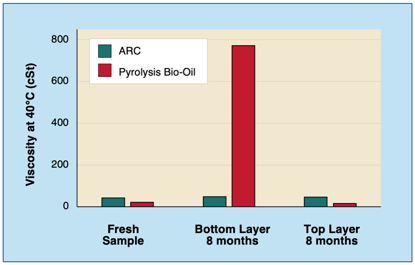
FIG. 1. Storage stability of neat ARC and fast pyrolysis bio-oil over 8 mos at room temperature. The viscosity of the top and bottom layers was measured to quantify the extent of stratification.
In practice, storage stability and thermal stability are linked. In addition to phase separation, viscosity growth during ambient storage can force refiners to process fast pyrolysis bio-oil within a narrow time window, which may not be compatible with refinery operations. Improved stability with ARC also reduces fouling risk in feed transfer equipment, including tanks, valves and heat exchangers.
These handling and logistics considerations can materially affect the complexity and capital cost of offsite systems required to manage biocrude feeds. As such, biocrude evaluation for FCC co-processing should include practical operability criteria, and not only conversion and product yields.
Pilot FCC testing approach. FCC co-processing tests were conducted at the U.S. National Laboratory of the Rockies using a circulating riser unit (CRU). The CRU is a continuous pilot-scale FCCU that replicates commercial riser hydrodynamics, catalyst circulation, catalyst regeneration and heat balance. Commercially relevant FCC catalyst designed for co-processing was used for testing and equilibrated beforehand. The unit was first operated on neat VGO to establish a steady-state baseline. Co-processing tests were then conducted at 12 wt% biogenic feed using either woody fast pyrolysis bio-oil or ARC at a constant catalyst-to-oil ratio, with all other operating parameters held constant. Liquid, gas, aqueous and coke products were collected with > 95% mass balance closure. Products were analyzed for total yields, biogenic carbon distribution via ¹⁴C analysis and trace oxygenates at the ppm level.
Impact of feed quality on FCC performance. ARC co-processing maintained overall FCC product distributions closer to the neat VGO baseline than fast pyrolysis bio-oil (FIG. 2). Although ARC co-processing results in a higher coke yield than fast pyrolysis bio-oil, this is a direct consequence of ARC’s higher conversion and lower bottoms yield under the tested conditions. In contrast, fast pyrolysis bio-oil produces more heavy bottoms and less coke, reflecting lower overall conversion. If fast pyrolysis bio-oil were processed to achieve the same level of bottoms conversion as ARC, its coke and water yields would be even higher due to its greater oxygen and water content. Preservation of the fossil-derived product slate remains essential for refinery economics, as margin continues to be driven primarily by petroleum product barrels rather than renewable products alone. Likewise, the potential to co-process ARC at higher blend levels is a key consideration when evaluating biocrude feeds for refinery decarbonization.
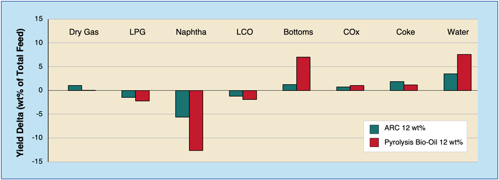
FIG. 2. Delta total product yields relative to neat VGO from co-processing woody fast pyrolysis bio-oil and ARC at 12 wt% blend. Delta total yields include both fossil-derived and biogenic contributions at a constant FCC catalyst-to-oil ratio. ARC preserves a product distribution closer to the VGO baseline, while fast pyrolysis bio-oil shifts total yield toward bottoms and water.
Biogenic product yields. On a biogenic feed basis, 14C analysis showed that ARC produced > 50% higher yields of total biogenic hydrocarbons than fast pyrolysis bio-oil (FIG. 3). A greater fraction of the fast pyrolysis bio-oil feed was diverted to the aqueous phase, coke and carbon oxide (COx), whereas ARC increased the proportion of biogenic carbon reporting to both gas and liquid hydrocarbon products. This improvement reflects ARC’s higher effective feed carbon and negligible water content. This distinction is critical for refiners, as renewable feeds deliver value only when incorporated into saleable fuels or chemical streams rather than low-value byproducts.
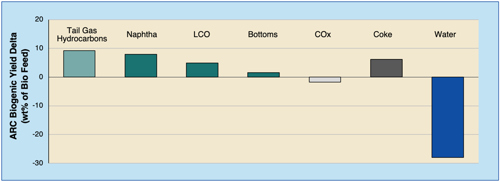
FIG. 3. Delta biogenic product yields from co-processing ARC relative to woody fast pyrolysis bio-oil at 12 wt% blend at a constant FCC catalyst-to-oil ratio. Biogenic yields were determined by 14C analysis. ARC increases the yield of biogenic gas and liquid hydrocarbons, with a modest increase in coke, while fast pyrolysis bio-oil diverts a greater fraction to COx and water.
Trace oxygenates and downstream implications. Although present at ppm levels, trace oxygenates can have outsized impacts on downstream systems. ARC produced approximately one-third of the total trace oxygenates in the liquefied petroleum gas (LPG) stream compared with fast pyrolysis bio-oil (FIG. 4). These differences are consistent with the removal of pyrolytic sugars during ARC production. Sugar-derived oxygenates tend to fragment into small oxygenated species that persist into lighter product streams, whereas stabilized lignin-derived structures may be more resistant to excessive fragmentation. Lower oxygenate breakthrough can reduce corrosion risk and operational burden on downstream systems not designed for oxygenate exposure. It is important to note that the LPG stream with ARC was not fully deoxygenated, and management of residual oxygenates remains important for downstream treating and finished product quality.
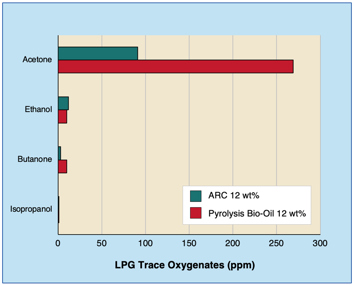
FIG. 4. Trace oxygenate concentrations measured in FCC gas products during co-processing of fast pyrolysis bio-oil and ARC at 12 wt%. ARC produces approximately threefold lower total oxygenates in the LPG range, reducing potential downstream impacts.
Takeaways. Continuous pilot-scale FCC testing shows that advanced lignocellulosic biocrudes can materially improve co-processing performance relative to untreated fast pyrolysis bio-oil. Compared with fast pyrolysis bio-oil, ARC preserved FCC product distributions closer to neat VGO, converted a greater fraction of renewable carbon into saleable hydrocarbons, reduced trace oxygenate carryover to downstream systems, and demonstrated improved storage and handling characteristics. The observed operability benefits of ARC relate to improved stability, lower water, lower metals and reduced oxygenate carryover, not to complete removal of organic oxygen or full resolution of feed acidity and associated feed-system materials compatibility requirements.
Taken together, these results show that biocrude feed quality, not just blend level or catalyst selection, is a primary driver of FCC co-processing outcomes. Advanced biocrudes such as ARC can reduce operational risk while improving renewable carbon efficiency, enabling refiners to capture renewable value without sacrificing FCC product slate or unit reliability. These feed quality improvements may also reduce the complexity of storage, transfer and preheat systems required for refinery integration, with potential capital and operability benefits beyond the FCC reactor itself.
FCC co-processing of lignocellulosic biocrudes should therefore be viewed as a feed design challenge as much as a process optimization exercise, where improvements in stability, biogenic product yields and oxygen speciation materially expand the practical operating window for renewable feeds using existing FCC assets.
NOTE
BASF’s contributions to this article were limited to catalyst development and application
LITERATURE CITED
1 van Dyk, S., J. Su, J. D. McMillan and J. Saddler, “Potential synergies of drop-in biofuels production with further co-processing at oil refineries,” Biofuels, Bioproducts & Biorefining, February 2019.


Comments