

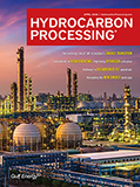
Reactors
Digital Feature: A novel process to help refinery operations comply with the U.S. Renewable Fuel Standard
This article, exclusive to Hydrocarbon Processing, details a novel refinery processing technology that enables refineries to produce fuels that adhere to the U.S. RFS.
Plastic pyrolysis oils as feedstock for steam crackers: Opportunities and challenges—Part 2
Plastic waste is a worldwide challenge. To reduce its carbon dioxide (CO<sub>2</sub>) footprint, the plastics industry is striving to increase circularity by using plastic pyrolysis oils (pyoils) from waste plastics as steam cracker feedstock.
Practical examples and considerations in designing emergency depressurizing systems
Process operating facilities typically process large inventories of gas and volatile hydrocarbon liquids at high pressures, which have the potential of posing major hazards during emergency incidents—such as fire, loss of containment or operating excursion.
Plastic pyrolysis oils as feedstock for steam crackers: Opportunities and challenges—Part 1
Plastic waste is a global challenge. Today, only a minimal amount of plastic waste is recycled, mostly mechanically.
Innovative approach to accelerating the startup of a gasoline block and associated units at Saudi Aramco’s Jazan refinery complex
This article elaborates on the startup of a refinery’s heavy naphtha reforming unit with an alternative approach to the initial unit design, including an evaluation of several startup techniques to ensure the adequacy and practicality of the selected option.
Izmit FCCU revamp
Tüpraş utilizes proprietary fluid catalytic cracking units<sup>a</sup> (FCCUs) at its Izmit and Izmir refineries. The Izmit unit was designed in 1968 and started up in 1972 with a side-by-side style reactor/regenerator.
Executive Viewpoint: A lifecycle assessment on chemically recycling plastics: A conversation with Neste’s Maiju Helin
HP spoke with Maiju Helin, Head of Sustainability and Regulatory Transformation Renewable Polymers and Chemicals, Neste, regarding Neste’s lifecycle assessment report on chemically recycling waste plastic.
Digital Exclusive: Bio-based aromatics give pathway to drop-in 100% SAF
In this digital exclusive, Iain Gilmore and David Kettner discuss a breakthrough process that provides the missing link to using 100% SAF in current aviation fleets and infrastructure: Bio-based aromatics.
How to gain an advantage from the propylene production gap—Part 2
This work will detail the available processing routes capable of maximizing propylene yield in refineries, allowing refiners to gain advantage from the propylene market.
Clariant’s catalyst chosen for Shenghong’s new world-scale biodegradable plastics project
Clariant announced that its SynDane 3142 LA catalyst will be used in Jiangsu Shenghong Petrochemical Co., Ltd's maleic anhydride production plant in Lianyungang, Jiangsu province, China.
- E.ON selects Capsol for carbon capture feasibility study in Norrköping 6/15
- China sets sights on heavy truck electrification in blow to diesel demand 6/15
- Fragile Iran deal offers oil relief, but Hormuz risks remain 6/15
- U.S. refiners can still absorb more Venezuelan oil, Energy Secretary Wright says 6/15
- From corn fields to cargo ships, ethanol gains early traction as marine fuel 6/12
- Indonesia raises price of widely used fuel by 32%, adds to cost-of-living concerns 6/12